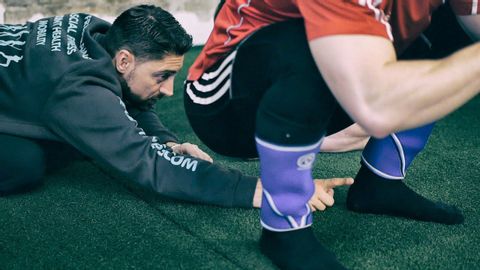
So what we want to know though is if anything is out of alignment all right if there seems to be some sort of an imbalance somewhere or if we looked at the going back to some of the terminology if there are any impairments that we're seeing you know with that posture well what are they well pes plantis lower cross and upper cross syndrome all right so if anything make sure that you know these three cat you know characteristics oh you know for the three distortion patterns because this might be something that pops up on your test that might say you know what distortion pattern is characterized by forward head and protracted round or rounded shoulders you'd say upper cross okay so let's get into the three of them first one is pes plantis if you look all right at the ankle joint you can see that you have what we would call a collapsed arch okay that collapsed arch is causing you to have what we would call eversion or the sole of the foot start to flare out all right the knee joint you can see if you look at the line of sight of the femur and of the tib fib you'll see that you're a little bit more bow-legged which we call knee valgus all right and there's a little bit of what we would call internal rotation meaning that the the femur is rotating in at the hip joint you can see here we're adducted we're pushing our knees together so we're going toward the midline and internally rotated as well now going through you can see the potential muscle imbalances pay attention to the over and under active muscles here as an overactive would be the gastrocnemius and the soleus so the calves are overactive the adductors are overactive pulling those knees in and the hip flexors as well which will cause internal rotation under active meaning that they need to be strengthened at some point overactive would need to be stretched under active are the anterior and posterior tibialis so that right in the front part of your shin here and the glute maximus and medius are not causing the femur to kick back and be externally rotated with lower cross that lower cross think about it from the perspective of positioning lower cross means lower back so what we're looking at here from the hip joint is what we would say is it's flexed you can see here that by flex meaning that we're pulling basically almost like the torso downward and you know causing this little bit of a shift in angle from upper to lower body the pelvis is anteriorly tilted you can drastically see that this person you know they almost have like a shifted butt meaning that their their butt is looks like it's raised and it's and you start to see that angled down and then of course your lumbar spine has that shift of really drastic really really drastic concave type of you know basically bending in motion so you're overactive here your hip flexors because the front is pulling so heavy and then your lumbar extensors of your low back are very aggressive at that point as well what are underactive are your glutes your glute maximus medius your hamstrings and your abdomen and they're not strong enough to hold you back into that position so it's basically allowing you to fall forward all right so that's lower cross syndrome then upper cross syndrome now this is extremely exaggerated but you get the idea upper cross is upper back lower cross is lower back upper cross you have that a little bit more of that hunchback shape with a forward head position posture so what we have like we said here the thoracic spine or that mid spine t1 to 12 is what we would call excessive kyphosis or hunchback where that positioning is flexed okay the shoulders are protracted they're a little bit more like rotated forward okay rounded forward not rotated excuse me and there's some internal rotation or like a turning in and then the head and the neck is jutted forward it's not that you are in extension or flexion it's just the cervical spine moves in that way so what are your overactives in this case well your pecs your pecs are gonna pull those shoulders forward the levator scapula and the sternocleidomastoid which are in the front portion of your neck are pulling you pulling that neck forward and your upper traps again are the upper traps are gonna pull forward that's what's rounded shoulder this rounded upper back things that are under active your mid and lower traps down in the lower region and then your rhomboids and they they are basically weak so they're not able to pull that back into posture and then your deep cervical flexors that are deep within the muscles that are gonna flex the neck that are you know those are gonna be weak too so it basically allows for everything to flop forward okay so you have no neck control at that point and that's why the head wants to do what it wants to do so all those are characterized by where the location is pes plantus is in the you know that's not as easy to remember but understand that that pes plantus is all about the feet and the feet and the legs whereas lower cross is lower back and upper cross is our upper back excuse me upper crosses upper back all right so those are what we would look for first these are static positions meaning that you are gonna have a person stand in front of you and you're gonna be looking for these types of environment now some of them are exaggerated but there are conditions that are a little bit you know again this is why pictures really can do a service and one of the other things you want to make sure to appropriate clothing for this is really gonna make a difference so the tighter that the tighter the fit of the clothing the better you can see these shapes of the person's posture so you know unfort like for a guy having a guy wear solely a pair of shorts would help greatly to see everything now again it's based on comfort but it would definitely help females a sports bra a sports bra halter top tank top and then shorts also make a huge difference so that you can see these locations and the more drapier they are the harder it is to see the outline of the body so it's harder to see where the dysfunction lies so we observed static we want to move into movement now now these are dynamic posture this isn't about strength or push-pull this is more about we're gonna put your body through some motion well actually push-pull would be part of this but it's we're gonna get into just body motion first before we introduce equipment is more like what we want to say all right so the movements that we're gonna do include some balancing some squatting some pushing and some pulling and it's gonna go overhead squat single leg squat a pushing exercise and then a pulling exercise in that order overhead squat single leg squat pushing assessment pulling assessment and we want to see again those five kinetic chain points and from anterior posterior and lateral lateral views so your overhead squat there's the starting position here if you notice the palms are facing forward person is extended completely all right and then we're gonna move them through so pay attention to your starting points you know foot and ankle complex is neutral we don't want to have toes flared in or toes flared out you know we want to be able to have our arms completely overhead our elbows this is where it gets tricky some people can't get to this position but we want to be elbows fully extended to that person's limitations now myself I can't mine look like they're not fully extended but it's just my posture or my the way that my structure of my arms are it looks like I have a slight little bend but I don't it's fully extended so you have to be very clear to say okay extend your elbows you know do not lock them unless you're having you know only or if you do lock them only lock them to a very light position all right so that we can get to that overhead in the proper way now it says here shoes off are preferable and I agree with that I mean shoes and socks would be great but if you can get at least the shoes off and have socks only that's what we want to do because we want to see what the feet do when we go into that squatting motion okay so again squatting what is the main thing here I mean obviously this is the anterior view this is the lateral view you can do a posterior view if you'd like but for now what we're seeing here is that we want to make sure that the femur is parallel to the ground that's the key point that's gonna be something that you probably will be asked on in a test okay us but again squat depth depending upon who the person is can be reduced based on their you know their ability level and if maybe they've had a pre-existing injury or anything like that okay so what you're gonna have them do five reps five reps and the first rep might look really good the fifth rep might look a little bit more not so good and that's because the body is adjusting and letting itself kind of you know you're you're a relaxing a little bit more in the positioning and so that when you're relaxed more surprisingly enough the muscles that are imbalanced if they are are gonna move and move you and so when you have the final ending position and you're watching this person go through that final ending range of motion you're gonna see on that fifth rep where that person really is and what they're really doing instead of the first couple reps they're really trying to make sure they're doing the reps right so this is you know again your anterior view looking for some some negatives here feet turning out slightly that would indicate external rotation the knees feet turning out that that could also mean that you might start getting some varus or the knees coming out but for right now we're looking at the toes toes and knees for this one here and if you notice this person's you know again their head is not an optimal alignment their shoulders are not an optimal alignment so there's a lot going on there that we're seeing just from the front but we'll see it more from the lateral side all right lateral can't get into full depth you know they can't get the full they can't get the hips down and that affects that whole upper positioning they might be able to start getting to full depth but then their lower back starts rounding in the center and then the other one is going to be their arms falling forward so although this person in the center has low back arching their arms are still in alignment whereas this person their arms are falling even though they might be an optimal you know spinal alignment so we're always paying attention to those impairments at that point.所以,我們想知道的是,是否有任何東西不對齊,好嗎,如果似乎有某種失衡的地方,或者如果我們看回一些術語,如果有任何障礙,我們看到你知道的姿勢,好吧,它們是什麼,好吧,足底下交叉和上交叉綜合徵,好吧,如果有的話,確保你知道這三隻貓,你知道的特徵哦,你知道的三種扭曲模式,因為這可能是你的測試中彈出的東西,可能會說,你知道的哪種扭曲模式的特徵是頭部前傾,肩膀圓或圓,你會說是上交叉 好吧,讓我們來了解一下這三種模式 第一種是足底畸形,如果你看一下踝關節,就會發現你有一個我們稱之為足弓塌陷會導致腳底外翻,或者腳底開始