ambulation
US
・UK
C2 高級
n. (u.)不可數名詞移動 ; 步行
The hospital encouraged early ambulation
影片字幕
頤養天年:有問必答--第 11 集 - 20 年 5 月 7 日 (IMMACULATE DISSECTION: Ask Us Anything - Episode 11 - 7/5/20)
55:00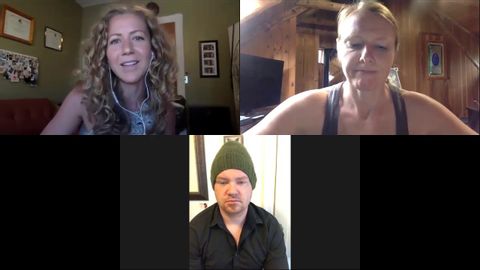
- I mean, this is a really actually cool thing to talk about right after we talked about diastasis, because again, if this person doesn't have that lateral rib expansion that we are looking for in our assessments, and they start to, you know, sort of brace, and aren't able to get some of that tissue extensibility, they will start to compress their hips via this iliopsoas fascia that starts to blend in at the front of the hips, and they'll start to jam the femur into the acetabulum for a sense of stability that's, you know, not really an authentic place of stability, it's just sort of a strategy, and so we see this happen a lot in people who start to get these C-shaped signs and symptoms, they'll get these pinchy-pinchy kind of popping, clicking stuff rolling around, you put them in like a tabletop or a supine 90-90, or any sort of hip flex position, and they start to get a lot of referral down into the anterior thigh. You're really just sort of looking at a redirection of force, and so, you know, your body's efficient, it's going to get something done, but it may not always get it done with the most optimal structures to do that with, and so we want to make sure that we get appropriate force transfer from the abdomen, and we get that pelvic stability there to then transfer into the lower extremity, and, you know, a possible pathway for that, if someone doesn't have it, is iliacus, and so we talk about, you know, the appropriate ways to decompress the hip, and versus what the typical ways that people try to decompress their hip are, which gets really dramatic in a lot of people, and they, you know, they start to look for love in all the wrong places, and try to, you know, stretch their hip flexors out, and it's not really a hip flexor problem as much as it's a hip flexor that's sort of trying to kick in and give you a sense of stability, so we do show ways to maintain your IDQs and decompress the hip in a way that it is safe, and not something that is, you know, going to put you at a risk of, like, a labral tear, or something like that, where someone all of a sudden breaches some tissue capacity, and goes into a tissue sensibility that they don't necessarily have, and just point out what you're talking about, Anna. Anna covers iliacus in a lot of detail in IDQ, and then the three of us discuss pectineus. Danny does some really great art on that, but when it comes to hip compression, it's intra-abdominal pressure loss from conjoint tendon, the connection to iliopsoas fascia, so you always want to check with someone who has the signs and symptoms of just feeling like a hip is jamming in its socket, pelvic inclination on that side, hip hike on that side is usually present, and then you can see, I think in the DVD I'm talking about this, typically you'll get Anna talking about this, but she's talking about iliacus, and does such a beautiful job of demonstrating that, but in this free video that we have on the OTP website, you can listen to a little excerpt of our DVD, where we give you a little sneak peek into IDQ, into when Anna describes this in a lot more detail, but you can see me on Dr. Jake Altman here showing that the person's in kneeling position, we're putting tension into the iliopsoas fascia here, to centrate the femur, and the person's breathing into the sides of the ribs, you see me cueing the sides of his rib cage, this is because muscles like transverse abdominis, internal abdominal oblique, they're attaching to that iliopsoas fascia that Anna's describing, and helping with force distribution, and what's actually flexing the hip, the irony of the matter, is not the hip flexors like Anna's describing, it's actually you get gut pressure, and then you cue this tissue to come up, and it's a reflexive cue, which is pretty fantastic to think about, because people blame the hip flexors for so much, and they end up weakening their hip flexors, and then they don't train them in flexion, and in ID we would never do that, we train things in all of their phases, so if we know that psoas and iliacus are contributors to this hip compressive thing, through their attachment to fascia, and their attachment to the chondroit tendon, then just nearby is pectineus, and pectineus is an adductor that's innervated by the same thing as iliacus, femoral nerve, so pectineus is innervated by part femoral nerve, that's the part that flexes the femoral nerve, and then there is the adductor portion, which is obturator, because the bowels go together, right, if you want to adduct, you use obturator nerve, and so the obturator nerve part of this jams the femur and the socket even more through adduction and internal rotation, so now your flexed adducted internally rotated position is what we call hip compression, and hip compression is healthy, it's present during the loading phase of ambulation, where see how Jake's leg is forward here, that's a hip compressed state, and that's a healthy state, he has a hip decompressed state on this side, meaning you have extension, abduction, and external rotation, so the de-approximation of the femoral head from the acetabulum, so in this phase, you'll see him EQing his breathing, having him annealing, and we're trying to decompress his hip, so for people in ID, what we try to get them to do is meet them where they're at, take them where they're not, try to analyze if it's the iliacus, it's the pectineus, if it's a breathing problem, or all three, and then we help them centrate the femur relative to their breathing and pelvic position, we do these things called pendulums, where we move them back and forth, and I was trying to find the YouTube of looking for love in all the wrong places, because Anna inspired us to do an Instagram of it, I'm trying to remember if I put it on the YouTube, let me see if I did put it on the YouTube, it looks like I didn't, so you'll have to go to our Instagram to find it, but if you go to our Instagram and look up iliacus pendulum, or hip flexor pendulum, actually I think it's called hip flexor pendulum, hold on, and then you'll see me showing the demonstration of looking for love in all the places, but watching Anna Falkner do it can never beat, I mean it's so good, it's so good, but let me look up hip flexor pendulum really quickly for you, see if I can find it, are you guys seeing my screen now, yes, yeah, basically if you see somebody trying to stretch their hip flexors, and it sounds like they should have like chariots of fire playing in the background, and you want to give them a streamer, they're probably doing it wrong, I know right, I was fairly certain that I had put it on YouTube, but I must not have, so which is a real shame, because it's really, really good, and I'll stop the share just so I can find it, but the way that we cue hip compression, the signs and symptoms of course are hip jamming at socket, you want someone to yank it out, pelvic inclination on that side, internal rotation with flexion bias, when they do a toe touch, usually their knee will bend, when you have various activities, you'll, the person always says they get relief when someone tractions their hip, so they've probably been assigned hip flexor stretches out the wazoo, and it's not going to get it done, just as Anna described, because first of all, the person feels an enormous amount of load in that position, so they may not actually like it, and so if they don't like it, they may not do it, oh I almost found it folks, if you go to our Instagram and our IGTV and you find it, it's called the hip flexor, I just scrolled past it on accident, my sincerest apologies, now I can't find it, so unfortunately you're going to have to do some hunting until I can upload it onto our YouTube, so I thought that
我的意思是,這是在我們談完腹膜膨出之後要談的一件很酷的事情,因為同樣,如果這個人沒有我們在評估中尋找的肋骨外側擴張,並且他們開始,你知道,有點像支撐,並且無法獲得一些組織的伸展性,他們就會開始通過髂腰筋膜壓迫他們的髖部,而髂腰筋膜開始在髖部前方融合、他們會開始將股骨塞入髖臼,以獲得一種穩定感,你知道,這並不是真正的穩定感,這只是一種策略,所以我們經常看到這種情況發生在那些開始出現 C 型體徵和症狀的人身上、你把他們放在桌面上,或者仰臥 90-90 度,或者任何一種屈髖姿勢,他們就會開始向大腿前側發出大量信
- I had, but I evidently did not, but if you go under our YouTube IGTV, you'll find it, it's hip flexor pendulum, so you can see me doing the dramatic version and the non-dramatic version, and that's a way to teach centration of the femur, because really what hip compression is, is de-centration with a bias towards flexion, adduction, and internal rotation, and so you're trying to get them to do that during healthy phases, and not doing that during phases where you want them to leave that position, it is healthy to compress the hip, particularly during the loading phase of ambulation, it is not healthy during the terminal stance phase, during the mid-stance phase, and so if they're carrying that hip compression into multiple phases of gait, it tends to become uncomfortable pretty fast, they show signs of iliopsoas bursitis, they show signs of just a jam sensation in the hip, an overstretched sensation in the posterior hip is usually present, none of which are comfortable for the patient, so those are your signs and symptoms, and what you can do about it is probably take ID2 and be a good idea to learn all the intricacies, because it's not as simple as saying, hey let's put them in kneeling and hope for the best, you have to know what to look for in that kneeling position, you have to know how to center them up, okay, I mean it's like taking 15 hours of instruction and putting it into like a 10 minute question, it's pretty tough, so hopefully we've been succinct enough to inspire you to study, and then we do have this article on OTP, you just type in OTP hip compression, and not only are it's basically a write-up about what we discuss, and also a free video, so you get a little sneak peek into that, so OTP hip compression, On Target Publications is the one who filmed our video for us, when we were fledgling at that point, we just had three IDs, now we have six, so we appreciate the question, okay, so we are still looking for questions from our live participants, if you guys have anything, I didn't miss anything, right? Nothing that was on Facebook, but one of our attendees that's in the chat right now has raised her hand, so person with hand raised, if you want to, if you're asking a question or you want to comment, maybe you can put that in the chat box, good, while they're thinking and typing, the chat box is to the left of the share screen at the bottom of your screen, we tend to not turn on your audio, just because we have to mute ourselves, even when we're talking, after we're talking for the feedback, for the recording, we want the recording to be a higher quality for you guys, so if you don't mind typing in the chat box, we can answer your question there, in the meantime, we've got some pretty exciting things coming up on the ID Collaborative this week, if you guys haven't heard of it, it is our learning series that we do, and every week we have two topics, and on Tuesday, we're talking about debunking psoas myths, and Anna and Danny made an absolutely awesome video on this, and it's like a one minute little snippet that we're going to tease you with during the talk on Tuesday, but we want to debunk a lot of myths about the psoas, one, the most important of which is that it's a hip flexor, which it's not that it doesn't act when in hip flexion, it's definitely active in hip flexion, but both of your psoas are active during one hip flexing, which means it's more complicated than most people think, and we also want to stop giving it for credit for things it doesn't deserve, and give it credit for things that it does deserve, like lumbar stability, but we want to take away the fact that everything that's wrong with your hip ever, especially in the front of it, is psoas. Notice how Anna was talking about hip compression, and we barely mentioned psoas. We mentioned psoas fascia, and we mentioned iliacus and pectineus, nearby brothers of psoas, but not psoas itself. Psoas gets blamed for so many things it doesn't deserve, and it's actually got a highway systems of nerves running through it, so that if psoas were really the problem all the time, then your genitalia, your front of your hip, your side of your hip, and your butt would constantly be numb, and luckily for all of us, we're not experiencing that on a regular basis, yet we're all still blaming psoas for all of our problems, and how it got named as the muscle of the soul, I still don't know. Now, Anna, you're vegan.
我有,但顯然我沒有,但如果你去我們的YouTube IGTV下,你會發現它,這是髖屈肌擺動,所以你可以看到我做的戲劇性版本和非戲劇性版本,這是一種教授股骨集中的方法,因為真正的髖關節壓縮是什麼?所以你要努力讓他們在健康的階段做到這一點,而不是在你希望他們離開那個位置的階段做到這一點,壓縮髖關節是健康的、尤其是在行走的負荷階段,在末期站立階段和中期站立階段是不健康的,是以,如果他們在步態的多個階段都壓迫髖部,往往會很快變得不舒服,他們會表現出髂腰肌滑囊炎的症狀,他們會表現出髖部卡住的感覺,通常會出現髖部後部